Last updated: February 10, 2026
Predictably Irrational vs Misbehaving: Head to Head Comparison
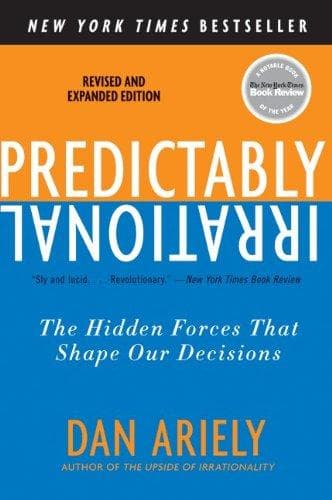
Predictably Irrational
by Dan Ariely
💡 We earn from qualifying purchases. Learn more
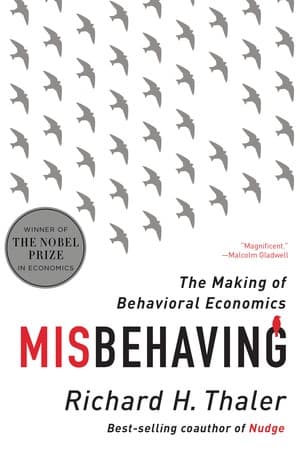
Misbehaving
by Richard H. Thaler
💡 We earn from qualifying purchases. Learn more
Quick Comparison
| Feature | Predictably Irrational | Misbehaving |
|---|---|---|
| Main Focus | Specific experiments revealing predictable patterns of irrational behavior | Historical journey of behavioral economics and intellectual battles with traditional economists |
| Writing Style | Experiment-driven, accessible, pop-science storytelling | Memoir-style narrative with academic history and policy applications |
| Key Concepts | Relativity, anchoring, free, social norms vs market norms, ownership effect | Mental accounting, endowment effect, nudge theory, planner vs doer |
| Approach | Chapter-by-chapter breakdown of specific irrational behaviors with experiments | Chronological story of how behavioral economics emerged and gained acceptance |
| Best For | Readers wanting entertaining examples of human irrationality | Readers interested in the intellectual history and policy applications |
| Practical Application | Understanding everyday decision-making and marketing tactics | Policy design, organizational behavior, and economic thinking |
| Page Count | 384 pages | 432 pages |
| Published | 2008 | 2015 |
| Feature | Predictably Irrational | Misbehaving |
|---|---|---|
| Main Focus | Specific experiments revealing predictable patterns of irrational behavior | Historical journey of behavioral economics and intellectual battles with traditional economists |
| Writing Style | Experiment-driven, accessible, pop-science storytelling | Memoir-style narrative with academic history and policy applications |
| Key Concepts | Relativity, anchoring, free, social norms vs market norms, ownership effect | Mental accounting, endowment effect, nudge theory, planner vs doer |
| Approach | Chapter-by-chapter breakdown of specific irrational behaviors with experiments | Chronological story of how behavioral economics emerged and gained acceptance |
| Best For | Readers wanting entertaining examples of human irrationality | Readers interested in the intellectual history and policy applications |
| Practical Application | Understanding everyday decision-making and marketing tactics | Policy design, organizational behavior, and economic thinking |
| Page Count | 384 pages | 432 pages |
| Published | 2008 | 2015 |
Strengths & Weaknesses
Predictably Irrational
✓ Strengths
- ✓FREE! experiment unforgettable: students chose free Kisses over discounted Lindt truffles even though truffle deal better (.14 vs .01)
- ✓Anchoring showed SSN digits control bids. SSN ending 80 bid average, SSN ending 20 bid . Random anchors control willingness to pay 60-120%
- ✓Social versus market norms framework: paying kids to help move couch destroys free willingness. Money converts relationships to transactional
- ✓Ariely burned over 70% of body, spent years in hospitals. Gives unique credibility on pain, decision-making under duress. Personal authority
- ✓15,600 ratings at 4.5 versus 5,800 at 4.4 shows broader resonance. Experiments translate across cultures, more widely read, more impactful
✗ Weaknesses
- ✗2021 data fabrication evidence in honesty experiments. Core experiments not proven fraudulent, but scandal taints Ariely's credibility overall
- ✗Doesn't explain HOW behavioral economics emerged or WHY economists rejected it. Experiments without intellectual context or historical battles
- ✗Replication crisis hit behavioral economics hard. Some Ariely experiments failed to replicate. Field has reproducibility problems
- ✗Reads like 'Wow interesting!' moments without unified theory. Know humans irrational but no framework predicting when or why they're irrational
Misbehaving
✓ Strengths
- ✓Thaler won 2017 Nobel Prize in Economics for this work. Learning from field's founding father, not popularizer. Ultimate credibility
- ✓The List genius—Thaler kept running list of economic anomalies (refusing offers even though > ). Watching List grow structures narrative
- ✓Mental accounting: drive 20 minutes to save on calculator but won't drive for on ,000 TV. Same , different mental accounts
- ✓Endowment effect: people value mugs they OWN 2x higher than mugs they could BUY. Explains hoarding, car negotiations, status quo bias
- ✓'Save More Tomorrow' program exploited present bias, got real people to increase retirement savings 3.5%/year. Proof behavioral works at scale
✗ Weaknesses
- ✗432 pages, 48 more than Predictably Irrational and denser. Memoir style means trudging through 1970s-1990s academic politics that drags
- ✗Thaler spends chapters gloating about proving economists wrong. 'I was right, they were idiots' tone gets old. Less humble than expected
- ✗Published 2015 but mostly 1980s-2000s research. By 2024, 'cutting-edge' insights are 15-40 years old. Feels dated versus current science
- ✗Only 5,800 ratings versus Ariely's 15,600 shows narrower, more academic audience. Not as broadly appealing despite Nobel Prize
Memorable Quotes
Predictably Irrational
💭 "We are really far less rational than standard economic theory assumes."
💭 "Humans rarely choose things in absolute terms. We don't have an internal value meter that tells us how much things are worth. Rather, we focus on the relative advantage of one thing over another."
💭 "FREE! gives us such an emotional charge that we perceive what is being offered as immensely more valuable than it really is."
💭 "When we are in a state of arousal, we are much more likely to behave in ways we would never consider when in a 'cold' state."
💭 "The problem is not that we are stupid; the problem is that we are human."
💭 "We systematically overvalue what we have."
💭 "Social norms are wrapped up in our social nature and our need for community. Market norms are very different; they are sharp-edged and hard."
💭 "Once market norms enter our considerations, the social norms depart."
Misbehaving
💭 "If you want to encourage someone to do something, make it easy."
💭 "Supposedly irrelevant factors (SIFs) are the key to understanding human behavior."
💭 "Humans are not perfect, but we can help them make better decisions."
💭 "The purely economic man is indeed close to being a social moron."
💭 "Mental accounting matters."
💭 "If you want people to stop doing something, make it harder."
💭 "The endowment effect is one of the most robust findings in behavioral economics."
💭 "People are not dumb. The world is hard."
💭 "Behavioral economics is not about proving people are stupid. It's about understanding how we think and making systems work better."
Why Read This?
Predictably Irrational
- •Discover why you make irrational decisions in predictable patterns
- •Learn how anchoring affects every negotiation and purchase
- •Understand the power of 'FREE!' and why it hijacks your brain
- •See how social norms vs market norms affect relationships and work
- •Perfect for understanding consumer behavior and marketing tactics
- •Entertaining and accessible—you'll finish it quickly and enjoy the ride
Misbehaving
- •Learn from the Nobel Prize winner who created behavioral economics
- •Understand the intellectual journey from economic heresy to mainstream
- •See how behavioral insights inform policy (Save More Tomorrow, nudges)
- •Get deeper understanding of mental accounting and endowment effect
- •Perfect for readers interested in economics, policy, and organizational design
- •More comprehensive and academically rigorous than pop-science alternatives
🏆 The Verdict
Predictably Irrational wins for entertainment and accessibility—15,600 ratings at 4.5 versus 5,800 at 4.4. Ariely's experiments (FREE!, anchoring with SSN, social versus market norms) are fascinating. You'll recognize yourself every chapter. Misbehaving wins for depth and intellectual history—Thaler's Nobel Prize work gives foundational theory, policy applications (Save More Tomorrow), and mental accounting framework. Read Ariely for fun insights, Thaler for comprehensive understanding.
Start with Predictably Irrational for entertaining insights. Ariely's experiments immediately useful—FREE! makes people choose Kisses over better Lindt deal, anchoring shows SSN digits controlling bids 60-120%, social norms dying when money enters ( payment destroys free help). At 384 pages you'll finish quickly recognizing yourself constantly. The 70% body burn story gives unique credibility. After Predictably Irrational, read Misbehaving if you want intellectual depth. Thaler's 2017 Nobel Prize work, The List of economic anomalies, mental accounting explanation (save on calculator but not TV), endowment effect (own mugs valued 2x buy mugs), and Save More Tomorrow program (real retirement savings increase 3.5%/year) give comprehensive foundation. At 432 pages it's denser with 1970s-1990s academic battles, but founding father credibility unmatched. If you only read one: Predictably Irrational for accessible behavioral insights. Add Misbehaving for complete behavioral economics education from Nobel laureate.
You Might Also Like
More comparisons in this category to help you make the right choice
Explore More Comparisons
Browse all our book comparisons across different genres
All ComparisonsExplore comparisons by category: Psychology & Human Behavior and more
Browse CategoriesHave a comparison request? We'd love to hear from you!
Request Comparison