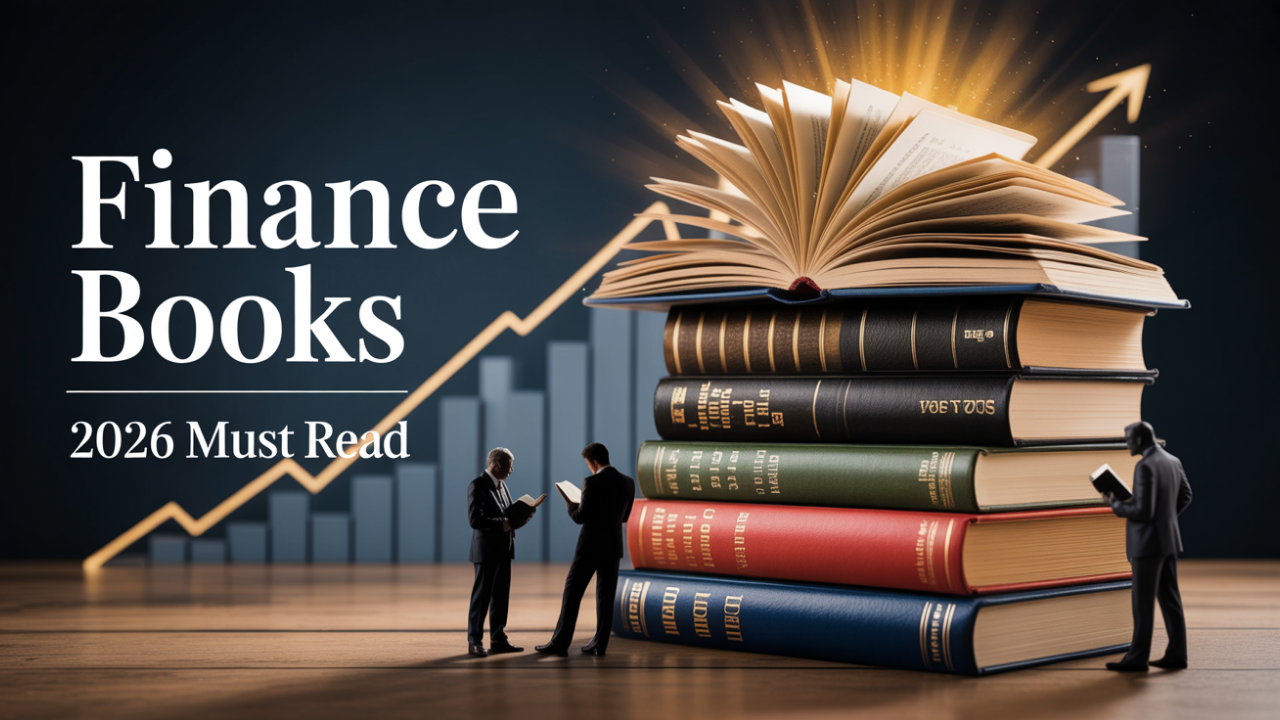
Warren Buffett spends 80% of his day reading. That’s not an exaggeration.
There’s a reason successful investors are obsessed with reading. The right book can completely transform how someone thinks about money, risk, and wealth-building. But walk into any bookstore and the “Finance” section is not a good thing to do.
So which books are actually good for you? Which ones will you remember five years from now?
The answer depends on what you’re trying to learn. Personal finance basics? Value investing? Understanding market psychology? Each area has its essential texts. Some books have been influencing investors for decades.
Let’s find Best Financial Literature Books out together.
# The Classics Financial Literature Books
Some books transcend their era. They’ve influenced generations and remain relevant today despite being written decades or nearly a century ago.
-
The Intelligent Investor by Benjamin Graham (1949)
Warren Buffett calls this “by far the best book on investing ever written.” That’s high praise from someone worth over $100 billion.
The book revolves around concepts like intrinsic value, margin of safety, and Graham’s brilliant metaphor of “Mr. Market.”
Mr. Market is your imaginary business partner who shows up every single day offering to buy your shares or sell you his shares at wildly fluctuating prices. Some days he’s optimistic and offers crazy-high prices. Other days he’s depressed and practically gives away shares for nothing.
The key insight? You don’t have to do business with him just because he shows up. You can ignore his mood swings and make decisions based on actual business value.
Graham writes: “The intelligent investor is a realist who sells to optimists and buys from pessimists.”
That simple sentence captures the entire philosophy. Buy when everyone’s panicking and prices are low. Sell when everyone’s euphoric and prices are inflated.
Another Graham principle that stuck with me: “In the short run, the market is a voting machine, but in the long run, it is a weighing machine.” Short-term, stock prices reflect popularity and emotion. Long-term, they reflect actual business performance and value.
-
Security Analysis by Benjamin Graham and David Dodd (1934)
If The Intelligent Investor is the accessible introduction, Security Analysis is the comprehensive textbook. This 700+ page tome dives deep into analyzing stocks, bonds, and other investments based on fundamental value.
Published during the Great Depression when markets were collapsing, the book provided a rational framework for navigating economic chaos. It’s dense. It’s technical. But it’s also the theoretical foundation that shaped Warren Buffett’s entire investment philosophy.
This isn’t light bedtime reading. It’s for serious students willing to work through detailed financial analysis and complex valuation methods. But if you want to truly understand value investing at its core, this is where it all started.
-
Common Stocks and Uncommon Profits by Philip Fisher (1958)
Philip Fisher taught Warren Buffett something Benjamin Graham couldn’t, and that is how to identify truly exceptional companies worth holding forever.
While Graham focused on quantitative analysis (numbers, ratios, balance sheets), Fisher pioneered qualitative analysis. What’s the quality of management? How strong are the company’s competitive advantages? What’s their capacity for innovation? Does the corporate culture support long-term success?
Fisher developed what he called the “scuttlebutt” method—talking to customers, competitors, suppliers, and former employees to gather insights that financial statements can’t reveal. It’s detective work.
Buffett credits Fisher with shifting his thinking from buying mediocre companies at bargain prices to buying outstanding companies at fair prices. That shift made him billions.
-
A Random Walk Down Wall Street by Burton Malkiel (1973)
This book argues something value investors hate: that stock prices already reflect all available information, making it nearly impossible to consistently beat the market.
Burton Malkiel presents the Efficient Market Hypothesis with compelling evidence. His conclusion? Most investors would do better buying low-cost index funds and holding them forever rather than trying to pick winning stocks or time the market.
Even if you disagree with Malkiel’s thesis (as many successful investors do), understanding the counterargument makes you a better investor. Plus, for regular people who don’t want to dedicate their lives to analyzing companies, his advice is probably right.
-
The Little Book of Common Sense Investing by John C. Bogle (2007)
John Bogle founded Vanguard and pioneered the index fund. His philosophy is beautifully simple: “Don’t look for the needle in the haystack. Just buy the haystack.”
This short, accessible book makes the case that most investors achieve better returns by buying broad market index funds and holding them long-term rather than paying high fees for actively managed funds that rarely beat the market.
The math is brutal. If the market returns 10% annually but your actively managed fund charges 2% in fees, you’re only getting 8%. Over 30 years, that 2% difference costs you hundreds of thousands of dollars.
Buffett himself recommended this book in his 2014 shareholder letter, suggesting most investors would benefit more from reading Bogle than listening to financial advisors trying to sell them expensive products.
-
Think and Grow Rich by Napoleon Hill (1937)
This classic focuses on mindset and psychological traits contributing to financial success. Napoleon Hill interviewed hundreds of successful business leaders and distilled principles like belief, persistence, desire, and goal-setting.
It’s more philosophical than practical, but the emphasis on personal growth as the foundation of financial growth continues inspiring readers nearly 90 years later.
-
The Richest Man in Babylon by George Clason (1926)
Through parables set in ancient Babylon, George Clason teaches timeless money management principles: pay yourself first, live below your means, invest wisely, seek expert counsel.
The storytelling format makes financial wisdom accessible and memorable. There’s a reason this nearly 100-year-old book remains popular.
-
Your Money or Your Life by Vicki Robin and Joe Dominguez (1992)
This book transformed how people think about the relationship between money, work, and life satisfaction. It introduces financial independence through conscious spending, tracking life energy expenditure, and aligning money decisions with values.
It’s foundational reading for anyone interested in the FIRE movement (Financial Independence, Retire Early).
# Books on Personal Finance
Before investing millions, you need to understand how to manage the money you already have.
-
The Psychology of Money by Morgan Housel (2020)
This book blew up for good reason. It’s currently ranking #1 on multiple bestseller lists, and it’s easy to see why Housel writes about money in a way that actually makes sense.
What is the core insight? Financial success has less to do with intelligence and more to do with behavior. Brilliant people make terrible financial decisions all the time. Meanwhile, ordinary people with good habits build substantial wealth.
Housel writes: “Saving is the gap between your ego and your income.” That one line hit me hard. Most people don’t have a spending problem; they have an ego problem. They spend money to impress others, to signal status, to keep up with neighbors and coworkers.
Another powerful passage: “Money’s greatest intrinsic value and this can’t be overstated, is its ability to give you control over your time.”
The book is full of these insights that reframe how you think about wealth. “Luck and risk are siblings. They are both the reality that every outcome in life is guided by forces other than individual effort.”
-
I Will Teach You to Be Rich by Ramit Sethi (2009, updated 2019)
Don’t let the clickbait title fool you. This is a practical, no-nonsense 6-week program covering budgeting, saving, investing, and negotiating.
Ramit Sethi’s approach emphasizes “conscious spending” – spend guilt-free on things that genuinely matter to you while ruthlessly cutting costs on things that don’t. Want to spend $200 on nice dinners? Fine, but stop wasting money on that gym membership you never use.
The book teaches practical strategies like automating your finances so saving and investing happen without willpower, optimizing credit card usage to build credit and earn rewards, and investing early in low-cost index funds.
Sethi’s style is direct and sometimes blunt, but he makes complex topics accessible and actionable.
-
Rich Dad Poor Dad by Robert Kiyosaki (1997)
This book is controversial. Critics point to Kiyosaki’s later questionable business ventures and seminars. But the original book has genuinely influenced millions to think differently about money.
The premise contrasts lessons from Kiyosaki’s two father figures—his biological father (poor dad) who worked a traditional job and struggled financially, and his best friend’s father (rich dad) who built wealth through entrepreneurship and investing.
Key concepts include understanding the difference between assets (things that put money in your pocket) and liabilities (things that take money out), making money work for you rather than working for money, and focusing on financial education rather than traditional schooling.
Love it or hate it, Rich Dad Poor Dad shifted mainstream conversation about money and wealth-building.
-
The Total Money Makeover by Dave Ramsey (2003)
Dave Ramsey offers a straightforward plan for eliminating debt and building wealth through his “Baby Steps” system and “Debt Snowball” method—paying off smallest debts first for psychological momentum rather than focusing on interest rates.
His approach emphasizes living completely debt-free, building emergency funds, and avoiding credit cards entirely. Many financial experts find his methods overly conservative (he hates all debt, even “good” debt like mortgages), but his system has helped millions escape crippling debt.
If you’re drowning in credit card debt or struggling to get financial traction, Ramsey provides a clear path forward.
# Advanced Investing and Strategy Books
Once the basics are solid, these books provide deeper insights into markets, strategy, and sophisticated thinking.
-
Principles by Ray Dalio (2017)
Ray Dalio founded Bridgewater Associates, the world’s largest hedge fund. This book shares the unconventional principles he developed over 40 years to achieve extraordinary results.
Only part of the book focuses directly on investing, and the rest covers decision-making frameworks, systematic thinking, and what Dalio calls “radical transparency.” But the entire approach applies to investment philosophy.
Dalio’s systematic method of understanding economic cycles, managing risk, and making decisions based on principles rather than emotions provides invaluable perspective for anyone serious about investing.
-
One Up On Wall Street by Peter Lynch (1989)
Peter Lynch managed Fidelity’s Magellan Fund to extraordinary returns by finding undervalued companies before Wall Street noticed them. His thesis? Average investors can beat professional money managers by investing in what they know.
Lynch encourages people to pay attention to everyday life. Notice which restaurants have lines out the door. Which products your kids are obsessed with. Which stores at the mall are always busy. These observations can lead to investment opportunities.
The writing is accessible and empowering—Lynch demystifies stock picking and shows regular people how to spot opportunities in familiar companies and industries.
-
Reminiscences of a Stock Operator by Edwin Lefèvre (1923)
This semi-fictionalized biography of legendary trader Jesse Livermore offers timeless lessons about speculation, market psychology, and human nature.
Despite being over 100 years old, the insights about fear, greed, and crowd behavior remain eerily relevant. Markets change. Technology advances. But human emotions? Those stay constant.
Traders and investors cite this as essential reading for understanding the psychological forces driving market movements.
-
The Outsiders by William Thorndike (2012)
This book profiles eight unconventional CEOs who excelled at capital allocation—the critical skill of deciding how to deploy a company’s resources for maximum shareholder value.
Warren Buffett praised it as “an outstanding book about CEOs who excelled at capital allocation” and has recommended it multiple times. The case studies demonstrate how exceptional leaders think about acquisitions, share buybacks, dividends, and operational investments differently than typical executives.
# Modern Must-Read Books
Recent publications addressing current financial realities.
-
Die With Zero by Bill Perkins (2020)
This provocative book challenges everything traditional retirement planning teaches. Bill Perkins argues people should spend money on experiences throughout their lives rather than hoarding it for old age or leaving massive inheritances.
The premise: Money exists to enable meaningful experiences. If you die with $2 million in the bank, you’ve essentially failed—you worked extra years, saved money you never enjoyed, and experienced less than you could have.
Perkins advocates optimizing life experiences at different stages. Hiking Machu Picchu at 30 is different than hiking it at 70. That beach vacation means something different to your kids at 10 than at 25.
It’s not about reckless spending. It’s about strategic deployment of resources to maximize life fulfillment rather than account balances.
-
The Algebra of Wealth by Scott Galloway (2024)
NYU professor and entrepreneur Scott Galloway distills financial success into a simple formula combining focus, stoicism, time, and diversification.
His direct, data-driven approach cuts through financial noise and provides actionable strategies for building wealth in modern economies. The book addresses contemporary challenges like student debt, housing costs, and career uncertainty that traditional financial books ignore.
Galloway writes like he talks; blunt, funny, occasionally profane, always honest.
-
Just Keep Buying by Nick Maggiulli (2022)
Finance blogger Nick Maggiulli tackles crucial questions with data-driven analysis. When should you save versus invest? How should you think about debt? What actually drives wealth accumulation?
The book debunks traditional personal finance beliefs through evidence-based strategies. Maggiulli uses actual data and research to challenge common assumptions and provide practical guidance.
It’s intellectually engaging while remaining practical—rare combination in finance books.
Where to Actually Start
With so many excellent books, where should someone begin?
Complete beginners: Start with The Psychology of Money for mindset, then I Will Teach You to Be Rich for practical systems.
Aspiring investors: Begin with The Intelligent Investor for value investing fundamentals, add The Little Book of Common Sense Investing for indexing perspective, then explore One Up On Wall Street for stock-picking insights.
Advanced investors: Dive into Security Analysis and Principles for theoretical depth, complement with The Outsiders for management analysis.
Rethinking money and life: Start with Die With Zero and Your Money or Your Life for fresh perspectives on wealth’s purpose.
The Bottom Line
Warren Buffett once said, “Read 500 pages like this every day. That’s how knowledge works. It builds up, like compound interest.” So, pick a book. Start reading. Knowledge compounds just like money.
Thank you for being with me.
Mehrab Musa From Asset Stories.