
The confusion starts because these aren’t competing choices. They’re different tools that often work best together.
A 401(k) is an employer-sponsored retirement plan. Your contributions come directly from your paycheck. Many employers match a percentage of what you contribute—typically 3% to 6% of your salary. That match is free money you’d be foolish to ignore.
A Roth IRA is a retirement account you open yourself with a brokerage. There’s no employer match. But you get complete control over what you invest in and when you access your money.
The biggest difference is how taxes work.
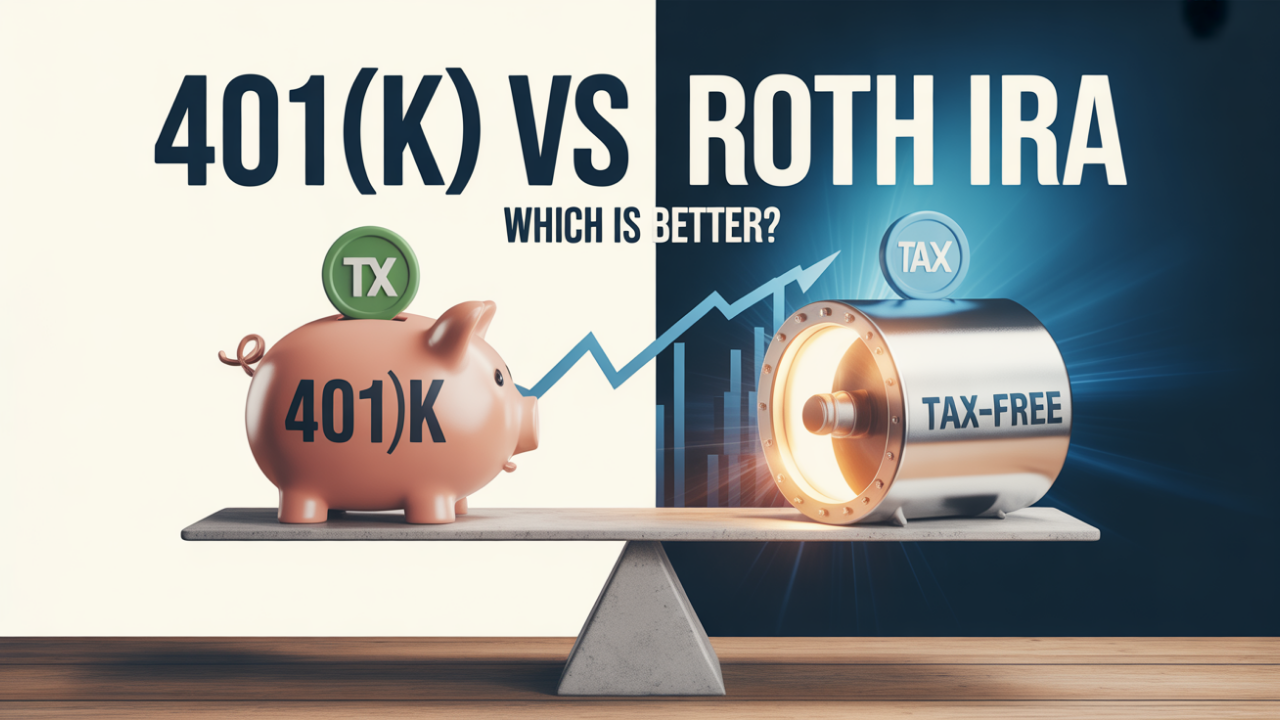
Traditional 401(k): You contribute pre-tax dollars. This reduces your taxable income today. But you’ll pay income taxes on every dollar you withdraw in retirement.
Roth IRA: You contribute after-tax dollars. No tax break today. But qualified withdrawals in retirement are completely tax-free, both contributions and earnings.
With a traditional 401(k), you’re deferring taxes. With a Roth IRA, you’re paying taxes now to avoid them later.
401(k) vs Roth IRA Contribution Limits for 2026
Let’s get specific about contribution limits for 2025 and 2026, because these matter more than you might think.
401(k) Contribution Limits:
-
2025: $23,500 if under 50
-
2026: $24,500 if under 50
-
Catch-up contribution ages 50-59 and 64+: Additional $7,500 (2025) or $8,000 (2026)
-
Special catch-up ages 60-63: Additional $11,250 (both years)
Roth IRA Contribution Limits:
-
2025: $7,000 if under 50, $8,000 if 50+
-
2026: $7,500 if under 50, $8,600 if 50+
You can potentially save more than three times as much in a 401(k) compared to a Roth IRA. If you’re serious about building retirement wealth quickly, that difference is massive.
The math that shocked me. Contributing the max to a 401(k) for 30 years at 7% annual returns could give you over $2.3 million. The Roth IRA max over the same period? About $700,000. Both are great, but one gets you there much faster.
When to Choose 401(k) Over Roth IRA
I used to think Roth accounts were always better because “tax-free withdrawals” sounded amazing. Then I actually did the math.
A traditional 401(k) makes sense when you expect to be in a lower tax bracket in retirement than you are now.
Let’s say you’re currently in the 24% tax bracket. You contribute $10,000 to a traditional 401(k), saving $2,400 in taxes this year. That money grows tax-deferred for 30 years.
In retirement, maybe you’re in the 12% tax bracket because you’re living on less income. When you withdraw that $10,000 (which has grown significantly), you pay taxes at 12% instead of the 24% you avoided earlier.
You basically got a tax arbitrage. Pay taxes when they’re low, avoid them when they’re high.
The traditional 401(k) also makes sense if you’re in your peak earning years. Most people earn the most money in their 40s and 50s. Using a traditional 401(k) during these years can significantly reduce your current tax bill.
And there’s another scenario nobody talks about. Suppose you’re a spender rather than a saver. According to research from Fidelity, if you’re likely to spend your tax refund rather than invest it, a Roth contribution might force more discipline because you’re not getting that tax savings back.
When Roth IRA Is Better Than 401(k)
Roth IRAs shine in specific situations, and I wish I’d understood these earlier.
If you’re young and in a low tax bracket. Your first few years of working, you’re probably in the 12% or 22% tax bracket. Pay taxes at these historically low rates now. Decades from now, you might be in a much higher bracket.
If you expect tax rates to increase. Current top federal tax rate is 37%. Sounds high, right? In 1981, it was 70%. In 1963, it was 91%. Tax rates are historically low right now. Many experts think they’ll increase in coming decades.
If you believe taxes are going up—whether for everyone or just for you personally—paying taxes today at current rates makes sense.
If you want flexibility. This is huge and nobody explains it properly. With a Roth IRA, you can withdraw your contributions anytime, tax and penalty-free. Not the earnings—just your contributions.
Say you’ve contributed $25,000 to a Roth IRA over five years, and it’s grown to $32,000. You can withdraw that $25,000 anytime for any reason without taxes or penalties. The $7,000 in earnings? Those need to stay until age 59½ unless you meet specific exceptions.
If you’re a high earner thinking about legacy. Roth accounts are becoming increasingly popular for estate planning. No required minimum distributions during your lifetime as of 2024. The money can grow undisturbed for decades and pass to heirs tax-free.
401(k) or Roth IRA: Decision Framework by Age and Income
“Better” choice depends entirely on your specific situation. Here’s my framework:
Your current age and income:
-
Under 30, earning under $60k: Roth IRA or Roth 401(k)
-
Ages 30-40, earning $60-100k: Split between traditional 401(k) and Roth IRA
-
Ages 40-55, earning $100k+: Lean toward traditional 401(k)
-
Ages 55+, high earner: Traditional 401(k), but consider Roth conversions in low-income years
Your expected retirement income:
-
Will your retirement income be higher than now? Roth accounts
-
Will your retirement income be lower than now? Traditional 401(k)
-
No idea? Split the difference
Your personality type:
-
Spender who needs forced savings? Roth (you won’t spend the tax refund if there isn’t one)
-
Disciplined saver who invests tax refunds? Traditional 401(k)
-
Want emergency access to contributions? Roth IRA
Your employer situation:
-
Generous employer match? Max the match first, always
-
No employer match? You have more flexibility
-
High-fee 401(k)? Contribute enough for the match, then prioritize Roth IRA
Using Both 401(k) and Roth IRA for Tax Diversification
Let’s say in retirement you need $70,000 to live on. If all your money is in traditional 401(k)/IRA accounts, that entire $70,000 is taxable income.
But if you have both traditional and Roth accounts, you could withdraw $40,000 from traditional accounts and $30,000 from Roth accounts. Now only $40,000 is taxable. You stay in a lower tax bracket.
This flexibility becomes even more valuable when you factor in Social Security taxation, Medicare premium surcharges (IRMAA), and other income-based benefits.
A financial advisor I spoke with called it “giving your future self options.” You can’t predict future tax laws or your specific retirement situation perfectly. Having money in both types of accounts lets you adapt.
Common 401(k) vs Roth IRA Mistakes to Avoid
Ignoring the employer match to max a Roth IRA. The employer match is a guaranteed 50-100% return. Nothing beats that.
Thinking you must choose only one. You can and often should contribute to both. Get the 401(k) match, max the Roth IRA, then go back to the 401(k) if you have more to save.
Not considering tax diversification. Having all traditional or all Roth creates risk. You’re betting on what future tax rates will be. Hedging with both types reduces that risk.
Forgetting about Roth 401(k) options. Many employers offer this and people ignore it. If you’re young or expect high retirement income, check if you have a Roth 401(k) option.
Withdrawing from accounts early. Both accounts have penalties for early withdrawal of earnings before 59½. Roth IRA contributions can be withdrawn anytime, but I’d avoid this except for true emergencies.
The Bottom Line: Which Is Better?
The 401(k) and Roth IRA aren’t competing options. They’re complementary tools.
For most people, the optimal strategy is:
-
Contribute enough to your 401(k) to get the full employer match
-
Max out your Roth IRA
-
If you can save more, go back and increase your 401(k) contributions
This gives you the employer match, tax-free Roth growth, investment flexibility, and extra tax-advantaged savings.
Thank you for being with me.
Mehrab Musa From Asset Stories Signing off.