
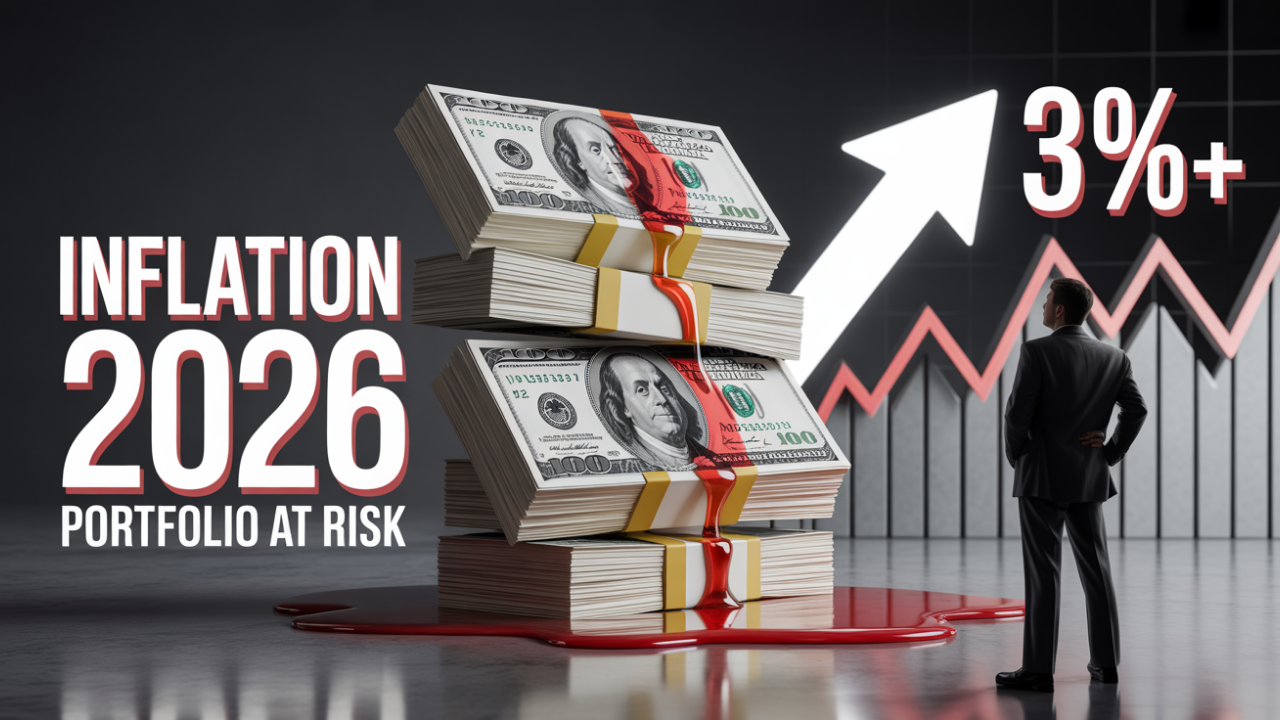
Understanding how inflation affects investment portfolio returns is critical as inflation hits 3-3.5%. U.S. inflation is projected to hit 2.7% in 2026. This is the lowest since 2020. 2021 was scary. 7% inflation. Can you imagine?
That might sound manageable. It’s not.
If you’re earning 5% returns on your investments but inflation is 3%, you’re only really making 2%. Your wealth is growing – just not as fast as you think. And for many investors holding traditional bonds or cash, inflation isn’t just slowing growth. It’s actively destroying wealth.
This guide shows exactly how inflation impacts stocks, bonds, and cash. And I will give proven strategies to protect your portfolio from inflation damage.
Real Returns vs Nominal Returns: Inflation’s True Impact
Your investment statement shows a 6% gain this year. Congratulations – you actually made 3%.
This highlights the difference between nominal returns and real returns. The formula is simple: Real Return = Nominal Return − Inflation Rate.
For example, in 2026, if your stocks earn 7% and inflation is 3%, your real return is 4%. If your bonds earn 5%, with inflation at 3%, your real return is 2%. Even worse, if your savings account earns only 0.5% while inflation is 3%, your real return is negative at −2.5%. That means your money isn’t just growing slowly – it’s actually losing value.
Now lets discuss How Inflation Affects Your Investment Portfolio
How Inflation Destroys Bond Portfolios
Bonds are getting crushed in the 2020s, and in my understanding, 2026 won’t be much different.
Inflation is particularly problematic for fixed income investments where regular interest payments remain fixed until maturity. You bought a bond paying 4% annually. Great. Except inflation is 3%. Your real return is 1%. And over time, the purchasing power of these payments declines in response to inflation.
Math on a 10-year bond:
Let’s look at a 10-year bond to see how inflation eats into returns. Imagine you invest $10,000 in a bond that pays 5% annually. that’s $500 a year. If inflation runs at 3% every year for the next decade, the story changes quite a bit.
In Year 1, your $500 payment still has the full purchasing power of $500. But the problem is, By Year 5, that same $500 is only worth about $430 in today’s dollars.
By Year 10, it’s down to $372. When the bond matures and you get your $10,000 back, that money is worth only around $7,440 in today’s dollars. Your “safe” investment has lost roughly 25% of its value to inflation. Did you want this? Definitely not.
When inflation is rising, bonds become less attractive, and their market prices fall. This creates a double hit. Your fixed payments lose purchasing power, and if you need to sell before maturity, you could take a loss because new bonds offer higher rates.
Historically, during the eight years of double-digit inflation in the U.S., bonds never recorded a positive real return – they lost an average of 12.19% per year. We’re not facing that extreme in 2026, but the principle is clear. Bonds plus persistent inflation can quietly erode your wealth.
How Inflation Affects Stock Portfolios
Yes, everybody knows, stocks generally handle inflation better than bonds, but it’s not always straightforward. In theory, a company’s revenues and earnings should rise along with inflation because businesses can increase prices to cover higher costs. For example, if Coca-Cola’s costs go up by 3%, they may raise prices by a similar amount, and over time, stock prices should reflect that growth.
If we look at history, stocks have indeed outpaced inflation. Since the 1960s, the average annual return for stocks has been around 11.5%. while inflation averaged 3.8%. Over the long term, stocks have consistently beaten inflation by a wide margin.
But in the short term, inflation can still hurt stock prices. Especially when it rises quickly. During the “Great Inflation” from 1965 to 1982, most stock declines happened within a year of inflation spikes. The reason is simple. When inflation jumps, the Federal Reserve raises interest rates to slow it down.
A recent example is 2022, when inflation surged. The S&P 500 dropped 18%. This is not because companies were failing, but because the Fed aggressively raised rates to control inflation. From my perspective, this shows why understanding inflation is crucial for anyone managing a stock portfolio.
Growth Stocks vs. Value Stocks in 2026
You might wonder knowing that not all stocks react to inflation in the same way. Historically, value stocks tend to hold up better when inflation is high. Growth stocks, on the other hand, usually perform best when inflation is low or stable.
Why is that? Growth stocks are priced based on earnings expected far in the future. When you discount those future profits to today’s dollars using higher inflation rates, their present value shrinks. Simply put, a dollar a company earns in 2030 is worth less if inflation is 3% than if it’s 2%.
Value stocks like energy companies, banks, and industrials often have pricing power. They can pass higher costs onto customers, and many pay dividends now rather than years in the future. That makes them more resilient in an inflationary environment.
Well, my suggestion for 2026, a smart stock strategy could be to tilt toward value stocks, companies with strong pricing power, and reliable dividend payers.
How Inflation Affects Cash Holdings? (Spoiler: It’s Losing Value)
Right now, high-yield savings accounts are paying around 4–5% annually. Sounds good, right? Not really.
With inflation at 3%, that “high-yield” savings is actually giving you only 1–2% in real returns. And if inflation continues at 3% in 2026 as projected, the real return shrinks even further. Cash is a depreciating asset in an inflationary environment. Sure, you need it for emergencies, but keeping too much wealth in cash guarantees you’ll slowly lose purchasing power over time.
An example: $50,000 in a savings account earning 4.5% grows to $51,495 after one year. Sounds great, but after adjusting for 3% inflation, the purchasing power is only about $49,997. In other words, you literally lost money, even though your account balance increased. From my perspective, this is why cash should be used wisely and not as a long-term wealth strategy.
6 Ways to Protect Portfolio from Inflation in 2026
You can’t stop inflation, but you can prevent it from quietly eroding your wealth. Lets discuss some option: (My point of views)
1. Increase Stock Allocation
One of the most effective ways is to increase your stock allocation, if you can tolerate some ups and downs. Historically, stocks have outpaced inflation over the long term, averaging about 11.5% annually compared to 3.8% inflation. If you have a decade or more before needing the money, stocks can serve as a powerful inflation hedge.
2. Add Treasury Inflation-Protected Securities (TIPS)
Another tool to consider is Treasury Inflation-Protected Securities (TIPS). These government bonds currently offer real, inflation-adjusted interest rates around 1.25% to 2%. That means you earn that rate plus whatever inflation comes along. If inflation hits 3%, your total return could be 4.25% to 5%, and your principal automatically adjusts with rising prices.
3. Consider Real Assets
Real assets such as commodities, infrastructure and precious metals can be effective inflation hedges.
Why? Because these assets increase in value as prices rise. When inflation hits, oil prices rise. Gold prices rise. Real estate values rise. These assets move with inflation, not against it.
But be careful: Commodities can be volatile, don’t produce income, and historically underperform stocks over the long run. From my perspective, it’s smart to limit them to 5–10% of your portfolio.
4. Favor Shorter-Duration Bonds
When it comes to bonds, favor shorter-duration bonds. A portfolio of bonds maturing in 2–7 years allows you to reinvest at higher rates as they come due. Long-term bonds, like 20–30 year maturities, lock you into low rates for decades.
5. Focus on Dividend-Growing Stocks
Dividend-growing stocks are another strategy. Companies that consistently raise dividends, think Johnson & Johnson, Procter & Gamble, Coca-Cola, often have pricing power. That means they can pass inflation costs onto customers without hurting profits. Their growing dividends can give you an inflation-adjusted income stream that bonds simply can’t match.
6. Rebalance Based on Real Returns, Not Nominal Returns
Finally, rebalance based on real returns, not nominal returns. Don’t celebrate a 6% gain if inflation was 5%. Because your actual gain was just 1%. Set portfolio goals based on real returns. Like aiming for 4% after inflation, and adjust your strategy to meet those targets. From my perspective, this mindset is key to truly protecting and growing your wealth over time.
Let’s Revise:
My calculation says, Inflation will hit 3% in middle 2026. Tariff impacts will add pressure through late 2026.
The investors who win in 2026 won’t be the ones with the highest nominal returns. They’ll be the ones whose real returns consistently beat inflation.
Start planning your 2026 portfolio adjustments ASAP. Every month you wait is another month inflation chips away at your wealth.
Thank You For Being With Me.
Mehrab Musa.
Founder, Asset Stories.