
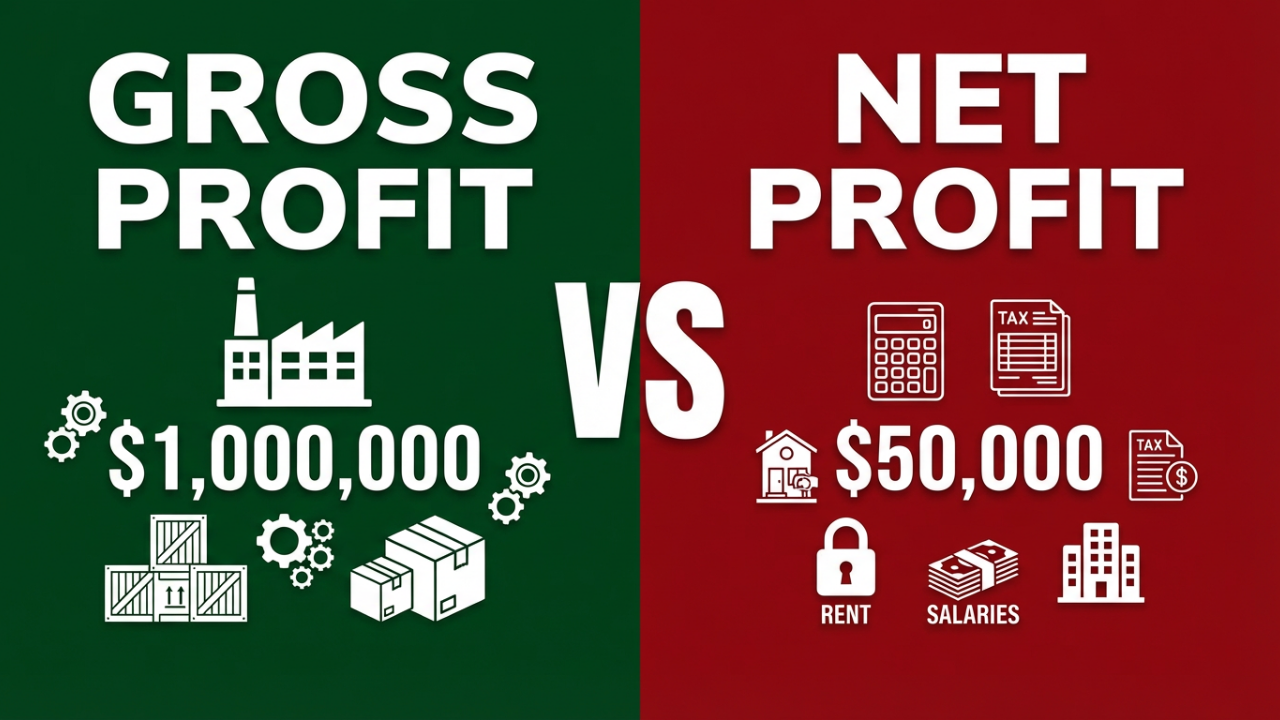
Understanding gross profit vs net profit is the difference between thinking you’re profitable and actually being profitable. Your business brought in $500,000 last year. Sounds great, right? But here’s the question that matters: how much did you actually keep?
That’s where gross profit and net profit come in. They might sound similar, but they tell completely different stories about your business’s health.
Let me break this down in a way that actually makes sense.
What Is Gross Profit? Definition and Calculation?
According to Vidhya Krishnan from Zoho Books, gross profit is the profit a business makes after subtracting all the costs that are related to manufacturing and selling its products or services. You calculate it by deducting the cost of goods sold (COGS) from your total sales.
Say, you run a bakery and sold cakes worth $20,000 last month. The flour, eggs, sugar, other baking ingredients, and direct labor totaled $8,000. Your gross profit calculation looks like this:
Gross Profit = Total Revenue – COGS
20,000 – 8,000 = 12,000
That $12,000 is your gross profit. It’s what you have left after covering the direct costs of making your product.
What Is Net Profit? How Does It Differ from Gross Profit?
Net profits are your total revenue, minus COGS and all operating expenses, that is administrative expenses, non-operating expenses like taxes or interest, and any expenses related to selling.
Net profit is what you actually keep after everything’s been paid. Rent. Salaries. Marketing. Insurance. Software subscriptions. Bank charges. Taxes. All of it.
Let’s revisit the bakery example. You made $12,000 in gross profit. But then you had to pay:
- Rent: 3,000
- Salaries for staff: 4,000
- Utilities: 500
- Marketing: 1,000
- Insurance: 300
Your net profit calculation:
Net Profit = Gross Profit – Operating Expenses
12,000 – 8,800 = 3,200
That $3,200 is your actual profit. That’s what you really made.
As Ian Agar from TechRepublic notes, net profit is what the business earns after all costs and overhead are paid. If this number is negative, the business lost money.
Gross Profit vs Net Profit: The Key Difference Explained
gross profit only considers direct production costs, while net profit accounts for everything.
Gross profit reveals how efficiently you generate revenue from production, while net profit shows your actual earnings after all business expenses. You calculate net profit by subtracting operating costs, taxes, and interest from your gross profit.
You might have an amazing gross profit of $200,000. That looks incredible until you realize your operating expenses are $195,000. Your net profit? Only $5,000.
Salesforce puts it clearly: gross profit shows the efficiency of production and sales, whereas net profit shows the overall profitability, including the effects of overhead and other operational costs.
Why Gross Profit and Net Profit Both Matter for Business
You might wonder why you need to track both. Can’t you just focus on net profit since that’s what you actually keep?
Not quite.
Gross Profit Shows Production Efficiency
Your gross profit tells you if your core business model works. Gross profit is a measure of how efficiently an establishment uses labor and supplies for manufacturing goods or offering services to clients.
If your gross profit is shrinking, something’s wrong with production. Maybe your suppliers raised prices. Maybe you’re wasting materials. Maybe your pricing is too low.
Net Profit Shows Overall Business Health
Net profit tells your creditors more about your business health and available cash than gross profit does, notes Krishnan. When investors want to invest in your company, they will refer to the net profit of your business to check whether it is worth investing their money.
They Work Together to Diagnose Problems
Bench Accounting explains this perfectly: if your manufacturing business has a high gross profit but a low net profit, you know your issue doesn’t stem from paying too much for direct labor and raw materials or pricing your product too low. You may need to take a closer look at your administrative expenses and cut costs there.
Gross Profit vs Net Profit Example:
Say you run a small clothing company called “Elegant Eyewear” (example from Bench Accounting). Here’s your year:
- Gross Sales: 400,000
- Returns: 15,000
- Cost of Goods Sold: 150,000
- SG&A Expenses: 50,000
- Interest Expense: 2,000
- Your gross profit:
Your net profit:
235,000 – 50,000 – 2,000 = 183,000
Both numbers appear on your income statement.
Average Gross Profit and Net Profit Margins by Industry?
Here’s something important: what counts as “good” varies wildly by industry.
The average gross profit margin across all industries is 36.56%, while the average net profit margin is 8.54%.
But that’s just an average. Look at the extremes:
Banks have gross margins near 100% (they have minimal production costs).
Retail businesses typically have net margins of 5-10%.
Software companies can have net margins of 20-40%.
Restaurants often struggle with net margins of just 4-8%.
The Finance Weekly notes that SaaS companies generally see net profit margins of 2-6%, while retail businesses typically hit 5-10%. Manufacturing faces significant overhead costs, keeping their margins at 7-12%.
Your target depends entirely on your industry. A 5% net margin might be excellent for a grocery store but terrible for a software company.
How to Improve Your Profits
To Improve Gross Profit:
Gross profit helps in pricing strategies and controlling production costs. Focus on Negotiating better prices with suppliers, Reducing waste in production, Adjusting your pricing strategy, Improving production efficiency
To Improve Net Profit:
Brex recommends several strategies for better overall profitability. Reduce operating costs (rent, utilities, unnecessary software), Automate processes to save labor costs, Cut expenses without affecting quality, Improve employee training to boost efficiency.
Putting It All Together
Gross profit is the sales income minus the direct costs of getting the article to sale. Net profit is the sales income minus all the business costs, as Starling Bank simply puts it. Both numbers are important. Track them both. Understand them both. Use them together to make better decisions about pricing, spending, and growth.
Thank you for being with me.
Mehrab Musa Signing off.